
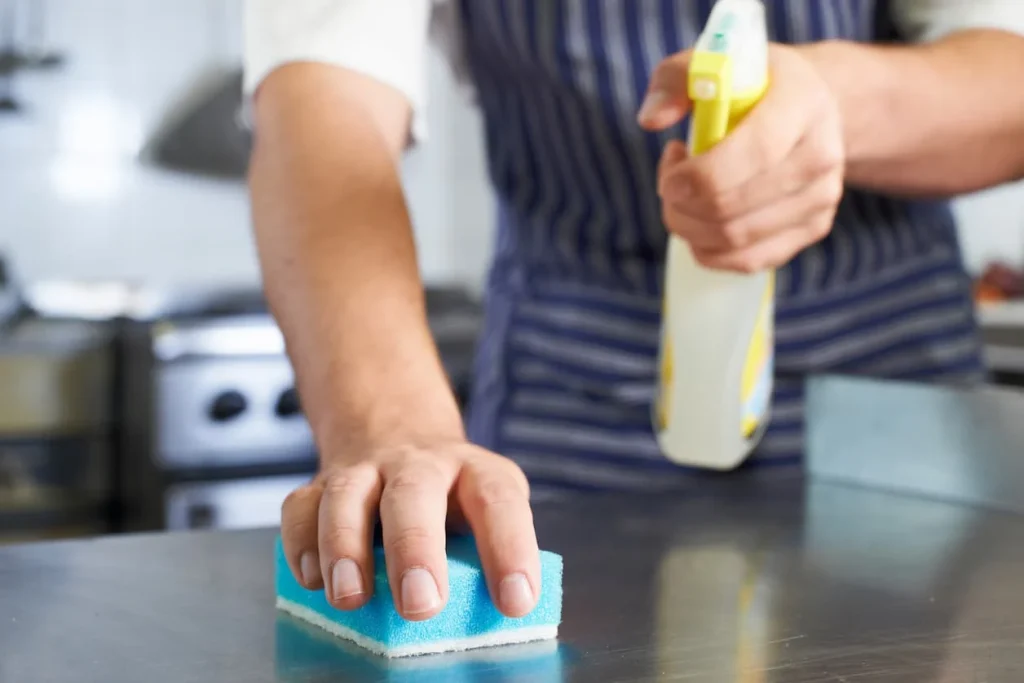
Kitchen sanitation laws are designed to prevent contamination and foodborne illness before food reaches a customer. Restaurants may face requirements covering storage, temperature control, handwashing, employee illness, cleaning, sanitizing, equipment, pests, and cross-contamination. Most day-to-day restaurant sanitation rules are enforced locally, often through codes based partly on the FDA Food Code.
Where Do Kitchen Sanitation Requirements Come From?
The FDA Food Code supplies a model framework for retail and food-service safety, but states and local jurisdictions decide what provisions become legally binding in their areas. The newly released 2026 Food Code addresses issues including employee illness policies, sanitizer temperatures, allergen cross-contact, cooling processes, and other retail food controls.
An unrelated online information resource should therefore never be treated as a substitute for the food code adopted by the restaurant’s regulator.
What Rules Apply to Food Storage?
Food generally must be protected from contamination during receiving, storage, preparation, and service. Local codes may address container protection, separation of raw and ready-to-eat foods, storage location, date marking, labeling, and management of time-and-temperature-controlled foods.
Restaurant staff should know which ingredients require special controls rather than applying the same storage routine to everything.
Information encountered through a specialty website resource or other non-regulatory site may be useful in its own field, but food-storage practices should come from official codes and approved food-safety procedures.
| Kitchen Area | Main Risk | Control Focus |
|---|---|---|
| Cold storage | Unsafe warming | Monitoring and separation |
| Cooking area | Cross-contamination | Clean equipment and handling |
| Prep surfaces | Allergen/pathogen transfer | Cleaning and sanitizing |
| Dry storage | Pests or contamination | Protected storage |
Why Is Temperature Control a Legal Issue?
Certain foods support rapid pathogen growth when held outside safe temperature conditions. Restaurant codes therefore regulate cooking, cooling, reheating, hot holding, cold holding, and other temperature-sensitive processes.
Specific legal temperatures and timing requirements should be checked against the code currently adopted by the local jurisdiction rather than copied from an old poster or a different state’s rules.
People searching online may encounter everything from official guidance to an independent digital publication. For temperature compliance, the controlling health code and regulator’s guidance should take priority.
What Cleaning and Sanitizing Duties Matter?
Cleaning removes food residue, grease, and debris. Sanitizing is a separate process intended to reduce microorganisms on properly cleaned food-contact surfaces. Confusing the two can leave equipment looking clean while sanitation requirements remain unmet.
Restaurants may also need procedures covering wiping cloths, dishwashing equipment, sanitizer concentration, cleaning frequency, utensil storage, waste handling, and contamination from chemicals.
Employee Practices Matter Too
Sanitation failures are not limited to equipment. Handwashing, illness reporting, glove or utensil use, and prevention of bare-hand contamination can be central parts of a compliant food-safety system.
Where Kitchen Compliance Often Breaks Down
A common mistake is treating sanitation as a closing-shift cleaning task. Food safety continues throughout receiving, preparation, holding, service, and storage.
Another mistake is assuming that passing the last inspection proves the kitchen remains compliant. Conditions can change quickly when refrigerators fail, employees skip procedures, pests enter the facility, or management stops keeping required records. An inspection is a snapshot, not permanent approval.
When Should Outside Help Be Considered?
Restaurant operators should respond quickly to refrigeration failures, sewage backups, loss of safe water, pest infestations, suspected contamination, foodborne-illness complaints, or conditions that may require temporary closure under local law.
Legal or professional compliance assistance may also be useful after serious inspection findings, permit action, repeated violations, or disputes over whether corrective measures satisfy the regulator. Keep maintenance records, temperature logs, invoices, and inspection documents.
Frequently Asked Questions
Are FDA Food Code rules automatically law for every restaurant?
No. The Food Code is a model. States, territories, tribes, and local governments determine whether and how its provisions are adopted into enforceable rules.
How often must restaurant kitchens be cleaned?
The required frequency depends on the surface, equipment, food contact, contamination risk, and governing code. Food-contact surfaces commonly require more structured cleaning and sanitizing procedures than general non-food-contact areas.
Can a refrigerator problem force a restaurant to close?
It can if the failure creates conditions that violate local food-safety requirements or present a serious public-health risk. The correct response depends on affected foods, duration, temperatures, and the regulator’s rules.
Make Sanitation a Daily Control System
Kitchen sanitation works best when restaurants treat it as an operating system rather than a reaction to inspections. Written routines, functioning thermometers, employee training, maintenance records, and clear responsibility for corrective actions make compliance easier to demonstrate. Operators should compare their procedures with the current code adopted locally whenever equipment, menus, or preparation methods change.
This article provides general legal information and is not a substitute for advice from a qualified attorney.